
Review of Albin 82 MS
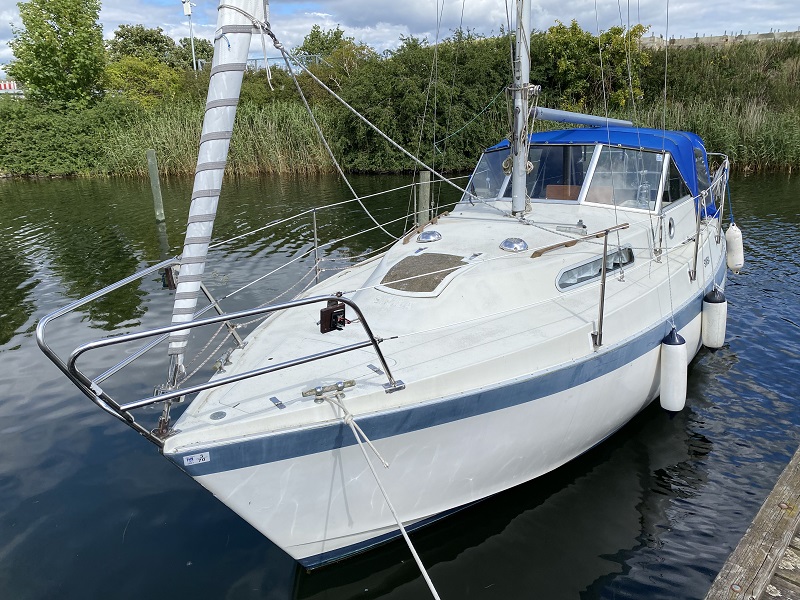

Basic specs.

Looking for a new boat? Find an Albin 82 MS or similar boat for sale
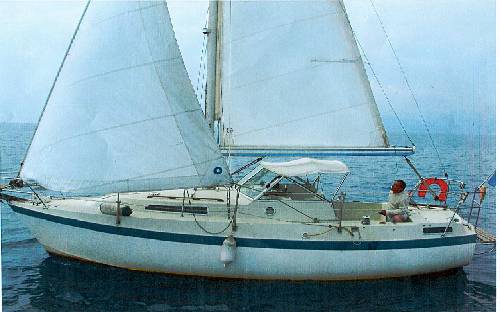
Both the hull and the deck is made of fibreglass. A hull made of fibreglass requires only a minimum of maintenance during the sailing season.
The deck is a sandwich construction which improves the indoor climate. Especially when the water is colder than the air in the cabin, then the double hull insulates against cold water and reduce the condense water in the cabin.
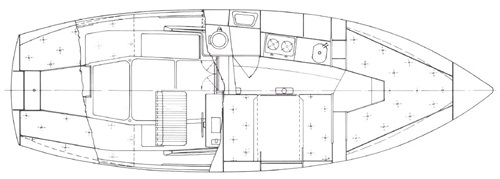
The boat is equipped with one cabin, 6 berths, a galley, 65 liters (17 US gallons, 14 imperial gallons) fresh water capacity and toilet facility.
Note: the boat has also been sold to be home-completed, which means that the quality of each boat may vary.
The Albin 82 MS is built with a masthead rig. The sail area for the mailsail + jib is 30.0 m2 (322.9 ft2). The advantage of a masthead rig is its simplicity and the fact that a given sail area - compared with a fractional rig - can be carried lower and thus with less heeling moment.
Fin keel
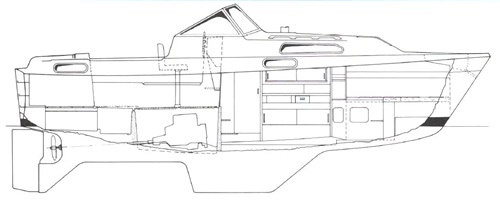
The Albin 82 MS is built with a fin keel. The fin keel is the most common keel and provides splendid manoeuvrability. The downside is that it has less directional stability than a long keel.
The keel is made of iron. Many people prefer lead keel in favour of iron. The main argument is that lead is much heavier than iron and a lead keel can therefore be made smaller which again result in less wet surface, i.e. less drag. In fact iron is quite heavy, just 30% less heavy than lead, so the advantage of a lead keel is often overstated. As the surface of a fin type keel is just a fraction of the total wet surface, the additional surface area created by the cast iron keel in comparison to a lead keel of the same weight would be negligible for cruising yachts.
Albin 82 MS can enter even shallow marinas as the draft is just about 1.20 - 1.30 meter (3.94 - 4.24 ft) dependent on the load. See immersion rate below.
The fuel tank, which is made of stainless steel, has a capacity of 125 liters (33 US gallons, 27 imperial gallons).
The boat may be equipped with an inboard Volvo Penta 17C diesel engine at 35 hp (26 kW). Cruise speed is 7.0 knots.
The transmission is a shaft drive. A shaft drive will in the long run require less maintenance than other types of drive e.g. a sail drive.
Sailing characteristics
This section covers widely used rules of thumb to describe the sailing characteristics. Please note that even though the calculations are correct, the interpretation of the results might not be valid for extreme boats.
What is Capsize Screening Formula (CSF)?
The capsize screening value for Albin 82 MS is 1.90, indicating that this boat could - if evaluated by this formula alone - be accepted to participate in ocean races.
What is Theoretical Maximum Hull Speed?
The theoretical maximal speed of a displacement boat of this length is 6.7 knots. The term "Theoretical Maximum Hull Speed" is widely used even though a boat can sail faster. The term shall be interpreted as above the theoretical speed a great additional power is necessary for a small gain in speed.
The immersion rate is defined as the weight required to sink the boat a certain level.
The immersion rate for Albin 82 MS is about 144 kg/cm, alternatively 811 lbs/inch.
Meaning: if you load 144 kg cargo on the boat then it will sink 1 cm.
Alternatively, if you load 811 lbs cargo on the boat it will sink 1 inch.
Sailing statistics
This section is statistical comparison with similar boats of the same category. The basis of the following statistical computations is our unique database with more than 26,000 different boat types and 350,000 data points.
What is Motion Comfort Ratio (MCR)?
The Motion Comfort Ratio for Albin 82 MS is 23.0 - 23.2.
What is L/B (Length Beam Ratio)?
The l/b ratio for Albin 82 MS is 2.89.
The ballast ratio for Albin 82 MS is 34%.
What is Displacement Length Ratio?
The DL-ratio for Albin 82 MS is 215 which categorizes this boat among 'moderate racers'.
What is SA/D (Sail Area Displacement ratio)?
The SA/D for Albin 82 MS with ISO 8666 reference sail is 14.3, with a 135% genua the SA/D is 17.0.
It is expected that motor sailers has a low SA/D value as this is the natural consequence of combining sailing and motor characteristics.
What is Relative Speed Performance?
The Relative Speed Performance for Albin 82 MS is 4
Maintenance
When buying anti-fouling bottom paint, it's nice to know how much to buy.
The surface of the wet bottom is about 23m2 (247 ft2).
Based on this, your favourite maritime shop can tell you the quantity you need.
Note: If you use a paint roller you will need more paint than if you use a paintbrush.
Dimensions of sail for masthead rig.


Are your sails worn out? You might find your next sail here: Sails for Sale
If you need to renew parts of your running rig and is not quite sure of the dimensions, you may find the estimates computed below useful.
| Usage | Length | Diameter | ||
| Mainsail halyard | 23.3 m | (76.4 feet) | 8 mm | (5/16 inch) |
| Jib/genoa halyard | 23.3 m | (76.4 feet) | 8 mm | (5/16 inch) |
| Spinnaker halyard | 23.3 m | (76.4 feet) | 8 mm | (5/16 inch) |
| Jib sheet | 8.2 m | (26.9 feet) | 10 mm | (3/8 inch) |
| Genoa sheet | 8.2 m | (26.9 feet) | 10 mm | (3/8 inch) |
| Mainsheet | 20.5 m | (67.3 feet) | 10 mm | (3/8 inch) |
| Spinnaker sheet | 18.0 m | (59.2 feet) | 10 mm | (3/8 inch) |
| Cunningham | 3.4 m | (11.2 feet) | 8 mm | (5/16 inch) |
| Kickingstrap | 6.8 m | (22.3 feet) | 8 mm | (5/16 inch) |
| Clew-outhaul | 6.8 m | (22.3 feet) | 8 mm | (5/16 inch) |
This section is reserved boat owner's modifications, improvements, etc. Here you might find (or contribute with) inspiration for your boat.
Do you have changes/improvements you would like to share? Upload a photo and describe what you have done.
We are always looking for new photos. If you can contribute with photos for Albin 82 MS it would be a great help.
If you have any comments to the review, improvement suggestions, or the like, feel free to contact us. Criticism helps us to improve.